Reconcile continuously — not in a scramble at period end.
In transaction-heavy companies, financial data arrives from banks, payment providers and internal systems that rarely agree on their own. Reconciling it by hand can consume analyst time, delay reporting and leave balances unexplained.
The gaps grow with volume, entities and channels.
Each source reports differently, timing windows don’t align, fees are applied inconsistently and currency adds another layer. Spreadsheets bridge the gaps — until volume, entities and channels multiply and the manual process can’t keep pace.
- Analyst time spent matching files instead of analysis
- Reporting delayed until reconciliation is complete
- Discrepancies and unexplained balances surface late
- Balances that are hard to trace complicate audit and review
These are common patterns, not claims about your specific environment. We confirm them in discovery.
What “good” looks like.
Continuous
Matching runs as data arrives, not once a month.
Owned
Every exception has an accountable owner and context.
Explainable
Balances trace back to the activity behind them.
Auditable
A reviewable record of matches and resolutions.
Reconciliation as continuous control.
Connect the sources
Bank, provider and ledger data are collected into one governed model.
Match automatically
Transactions and balances are reconciled across sources, accounting for timing, fees and currency.
Route exceptions
Each break is assigned to an owner with the context needed to resolve it.
Explain the result
Reconciled balances are designed to trace back to source activity.
What you operate day to day.
Multi-source matching
Reconcile across providers, channels, currencies and timing windows.
Exception ownership
Assignment, context and resolution history for every break.
Source-to-report lineage
Trace a balance to the transactions that produced it.
Capability availability is confirmed per environment. We do not present roadmap items as released features.
Measured against your baseline — no guaranteed numbers.
Reconciliation you can see.
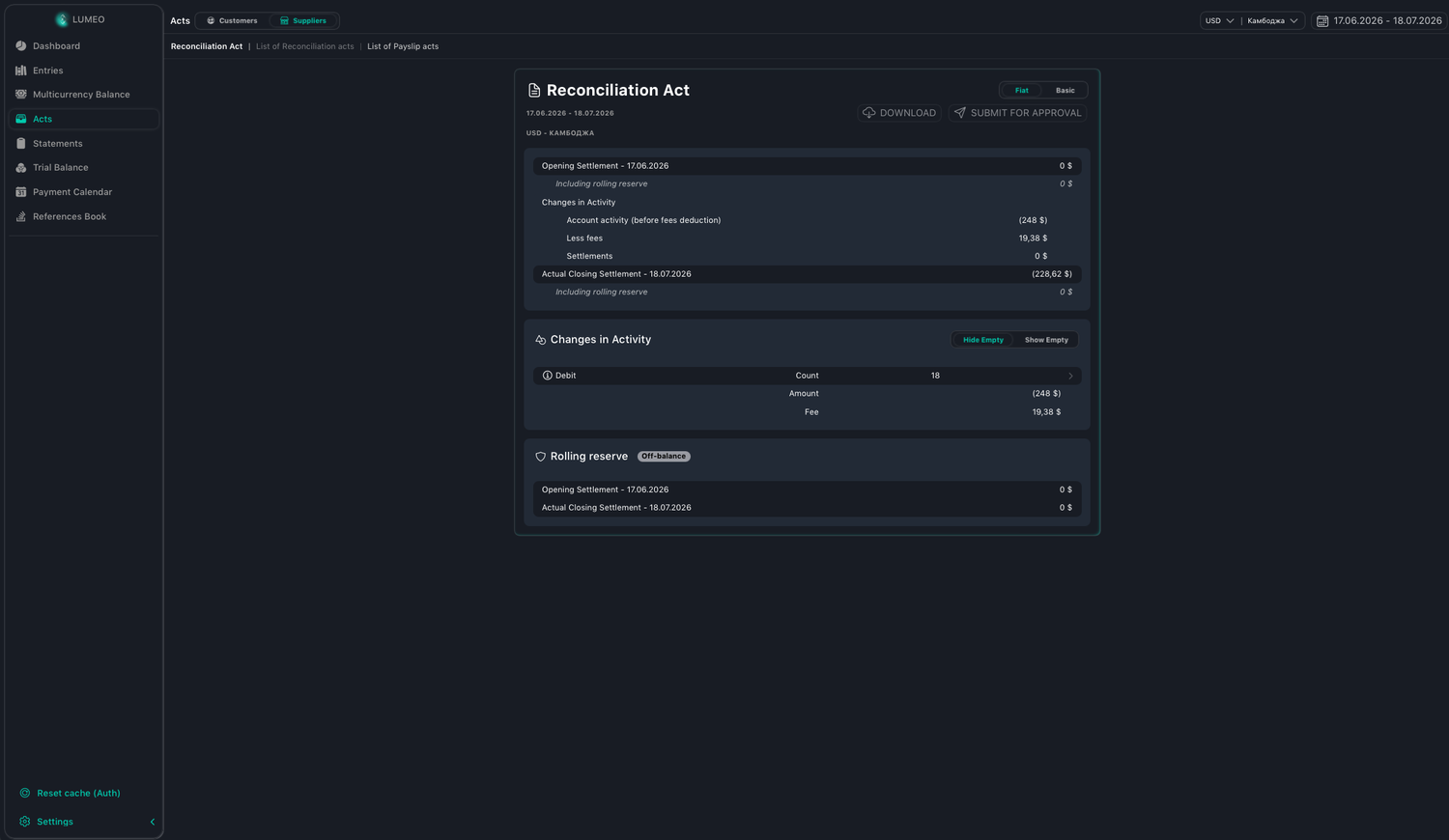
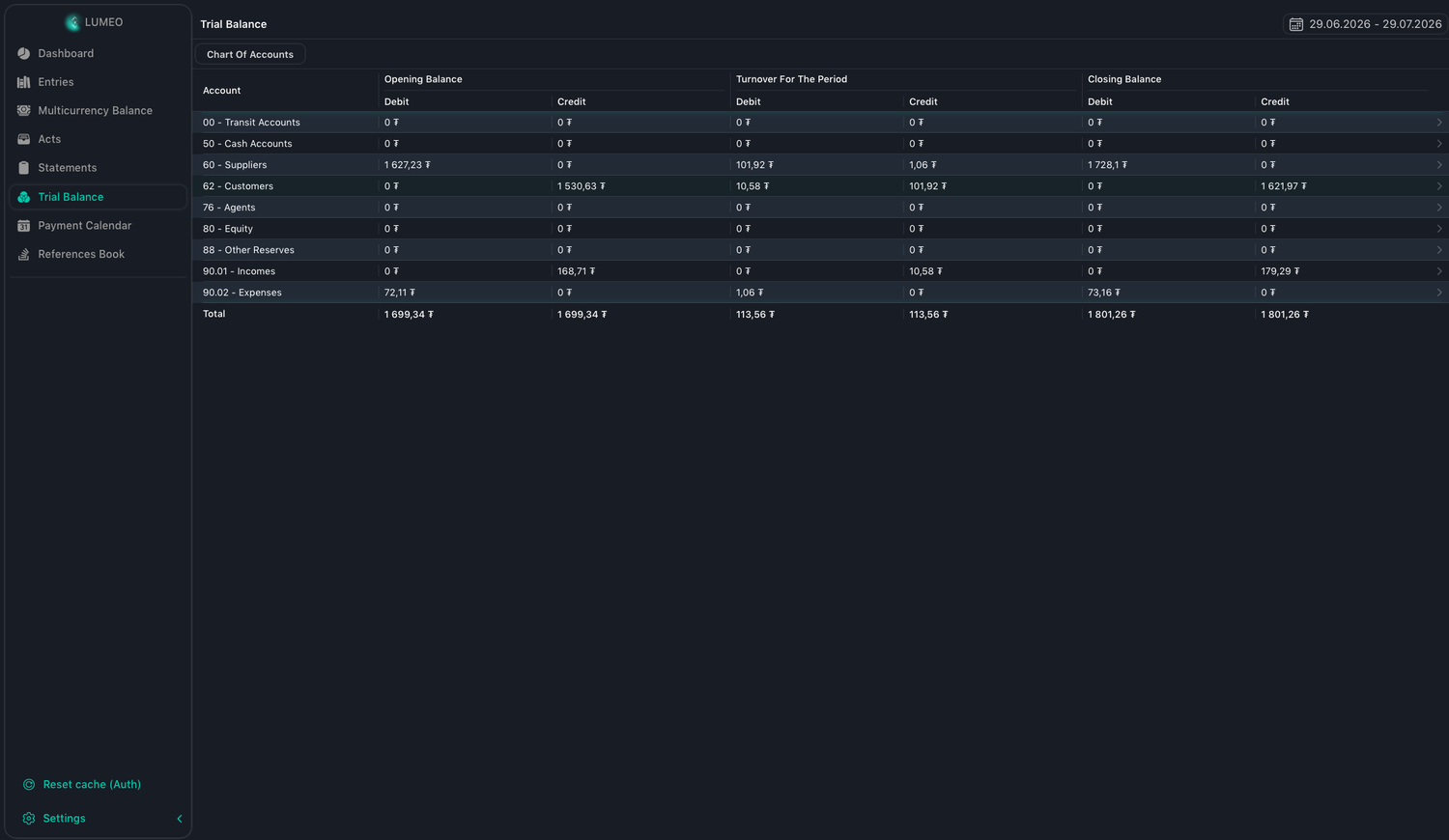
Real product screens: a reconciliation act from opening to closing settlement, and the trial balance behind it. Counterparty identifiers anonymized; figures from a test environment.
What a first reconciliation flow needs.
Access to sources
Connectivity to the relevant bank, provider and ledger data for one flow.
A documented baseline
Current process, volumes and break rates to measure against.
An accountable owner
A finance owner for exceptions and sign-off.
We do not promise a match rate, implementation timeline, savings or accuracy without approved evidence.
Discuss your reconciliation workflow.
Tell us about one flow you want to reconcile continuously. We’ll review it with you and outline a realistic next step.