Continuous financial control for transaction-heavy companies.
Lumeo turns fragmented financial data into trusted, continuously controlled intelligence for payment, fintech and transaction-heavy companies.
Financial Intelligence. Continuously Controlled.
Financial decisions are only as reliable as the data and controls behind them.
When financial information is spread across banks, payment providers and internal systems, finance teams can spend excessive time reconciling files, investigating discrepancies and explaining balances. The specifics differ by company — these are the patterns we most often hear in discovery.
Fragmented data
Transaction and balance data sit in separate systems that may not agree without manual effort.
Manual reconciliation
Matching files across sources can consume analyst time and delay reporting.
Late exception detection
Discrepancies and unexplained balances may surface only at period end.
A control layer between financial data and business decisions.
Continuous Financial Control is a distinct discipline: unify financial information, validate and reconcile it, apply defined controls, and only then turn trusted results into intelligence. Lumeo is designed as a governed layer across your existing systems.
A five-stage financial control workflow.
Control is applied at each stage — so intelligence rests on validated data, not assumptions.
Connect and normalize financial data
Bring data from banks, payment providers and core systems into a consistent, permissioned model.
Validate and reconcile flows
Match transactions and balances across sources and surface differences.
Apply defined financial controls
Codify the controls your finance function relies on so they run consistently.
Manage exceptions and ownership
Route each exception to an accountable owner with context.
Convert trusted results into decision-ready intelligence
Produce explainable balances and reporting that trace back to source activity.
Value dimensions finance teams can measure.
Lumeo is designed to move these dimensions against your own baseline. We do not publish guaranteed results — targets are established with you during discovery.
Start with the control that costs you most.
Financial Reconciliation is our published use case today. The others describe intended coverage of the platform and are being detailed for release.
Financial reconciliation
Continuous matching across banks, providers and ledgers, with owned exceptions.
Explore
Settlement control
Reconcile provider, scheme and bank settlement across channels.
Fee management
Compare charged fees against agreed terms to surface discrepancies.
Cash & liquidity visibility
A traceable view of cash and settlement positions.
Multi-entity finance
Consistent controls across entities and currencies.
Profitability intelligence
Margin and fee analysis by customer, provider and entity.
Cards marked “intended coverage” describe the platform’s design direction, not released features. See the platform page for current status.
Built first for payment and transaction-heavy businesses.
In payment companies, a single transaction can pass through several parties before it becomes trusted cash — each with different timing, fees and currencies. That complexity is where reconciliation breaks and where continuous control matters most.
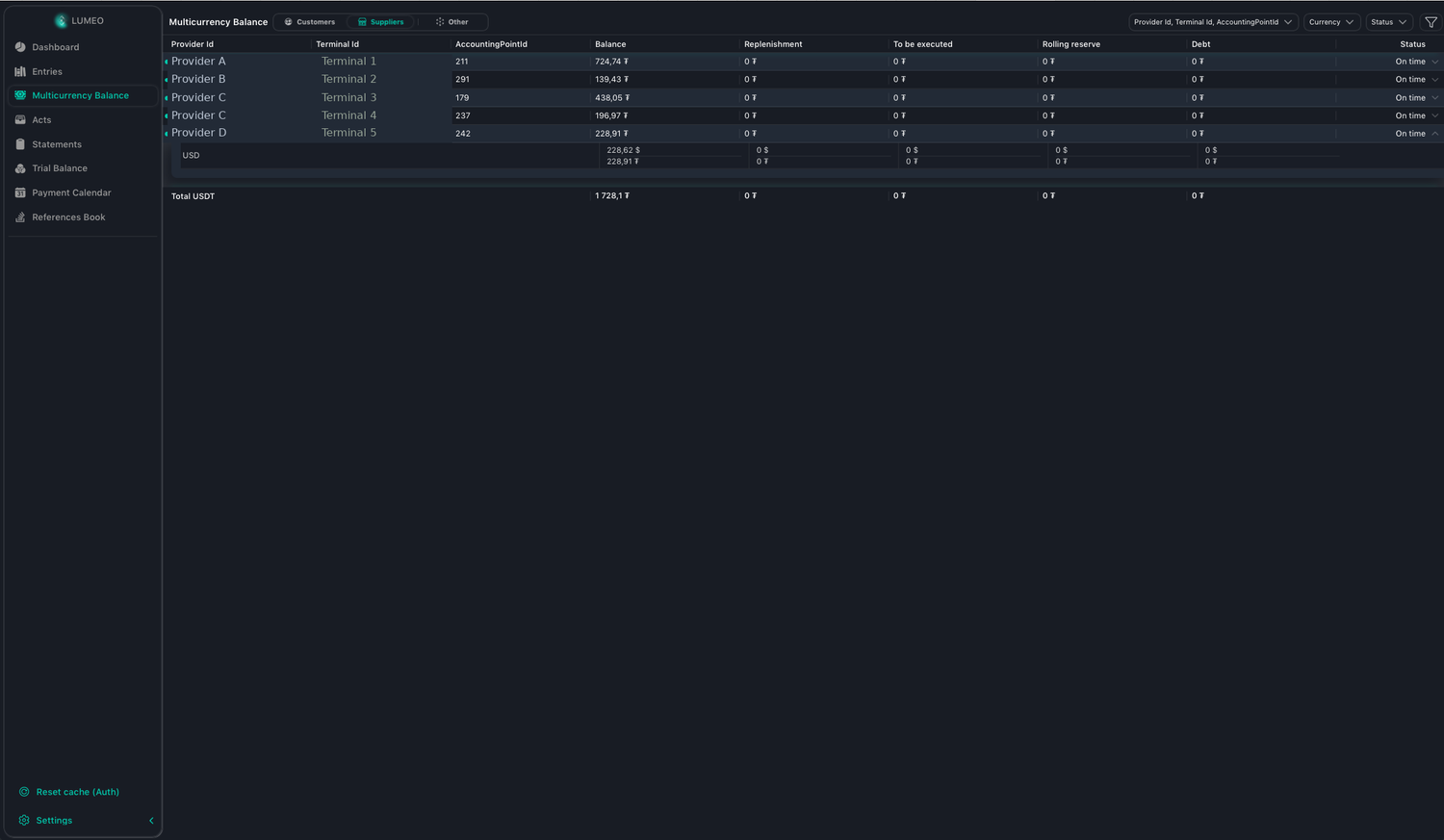
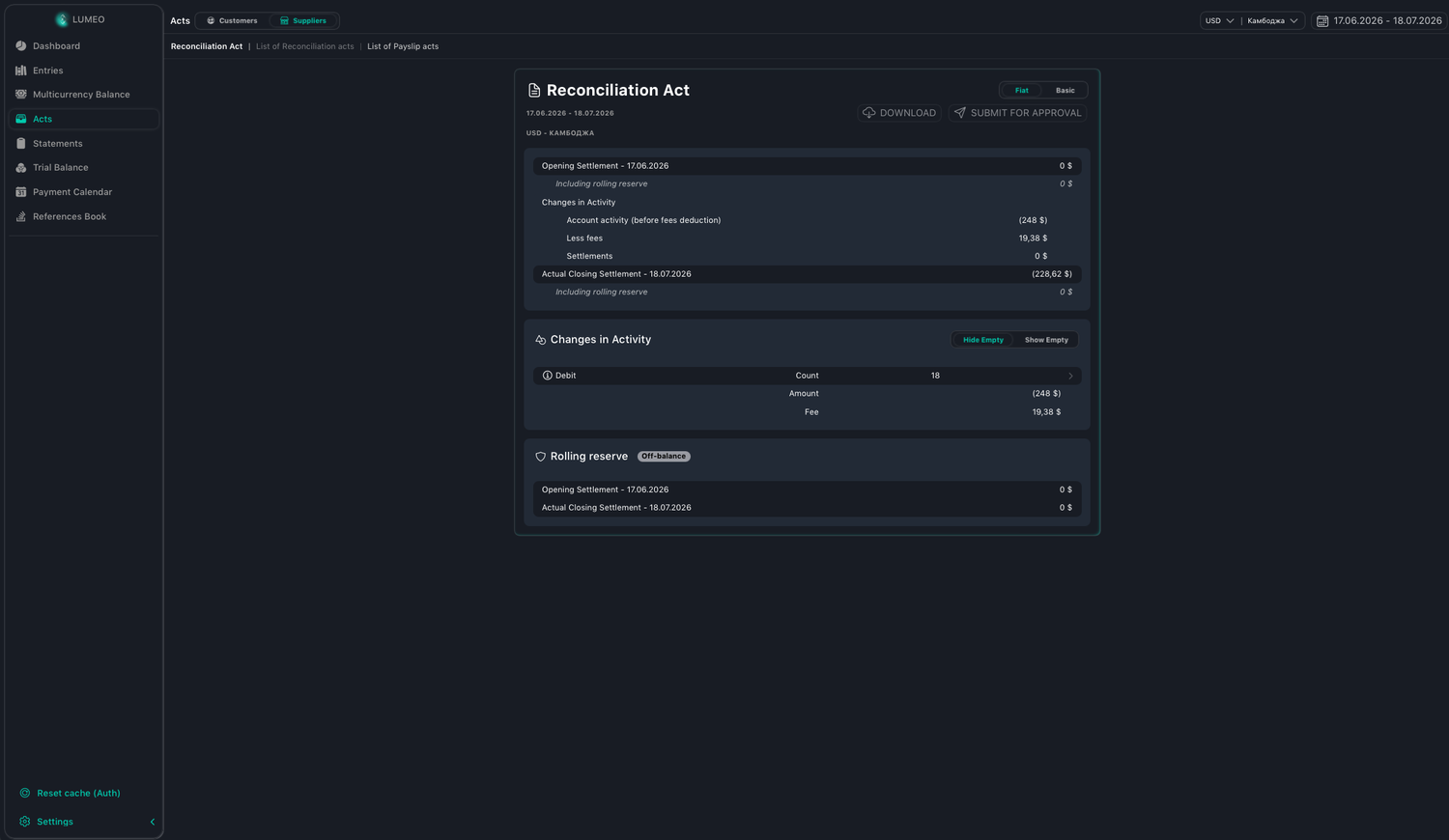
See the product, not just the promise.
Real screens from the platform: continuously reconciled balances and decision-ready statements. We still don't publish customer names, logos or metrics without permission — identifiers below are anonymized.
Data validation first
Analysis follows validation and reconciliation — not the other way around.
Explainability & lineage
Results are designed to trace back to the source activity behind them.
Governed AI
AI is applied after validation and control, on permissioned context.
Designed for finance teams and their governance stakeholders.
These are the design principles we can state today. Specific certifications, encryption standards, data residency and service levels require approval before they appear as claims.
Validation before analysis
Trusted data is a prerequisite, not an assumption.
Explicit rules & permissions
Controls and access are defined, not implicit.
Explainability
Balances and exceptions are designed to be explainable.
Auditability
Controls, exceptions and decisions are designed to be reviewable.
Human approval for material actions
Autonomy is introduced in controlled, supervised stages.
Integration with the existing stack
Lumeo complements ERP and finance systems rather than replacing them.
Independent, focused, finance-first.
2024
Dubai, United Arab Emirates
Founded 2024 · Headquartered in Dubai · Team of 11. Company facts are managed centrally in the site configuration. About Lumeo →
Discuss your financial control workflow.
Tell us which financial process or control you are looking to improve. A member of the Lumeo team will review your request and follow up.